Photographic album of Delphi. The site, famous for the Temple of Apollo and the oracles of the Pythia —whom kings and rulers from all over Greece came to consult— situated at an altitude of 570 meters on the slopes of Mount Parnassus, was also considered the center of the world by the ancient Greeks, symbolized by the sacred stone of the Omphalos (“the belly button”), at the spot that Zeus himself marked while searching for the center of his homeland, Gaia (the Earth). The sanctuary of Delphi developed between the 8th and 4th centuries BC, and it remained in use until the arrival of the Gauls around 173 BC and until the worship of Apollo was banned by Theodosius in AD 392.
 The tholos of Delphi - Temple of Athena Pronaia | 1
The Tholos of Delphi is a circular structure from the 4th century BC which is located below the sanctuary of Delphi, near the Gymnasium, and is part of the temple of Athena "Pronaia" — that is, the one which is upstream of the sanctuary.
The tholos of Delphi - Temple of Athena Pronaia | 1
 Delphi: the sanctuary of Athena Pronaia | 2
Delphi: the sanctuary of Athena Pronaia | 2
 Delphi: the sanctuary of Athena Pronaia | 3
Front side of the temple of Athena Pronaia.
Delphi: the sanctuary of Athena Pronaia | 3
 Delphi: the Tholos or Temple of Athena Pronaia | 4
Delphi: the Tholos or Temple of Athena Pronaia | 4
 Delphi: the Tholos or Temple of Athena Pronaia | 5
The Temple of Athena Pronaia, with the main site of Delphi in the background.
Delphi: the Tholos or Temple of Athena Pronaia | 5
 Delphi: ruins of the Christian city | 1
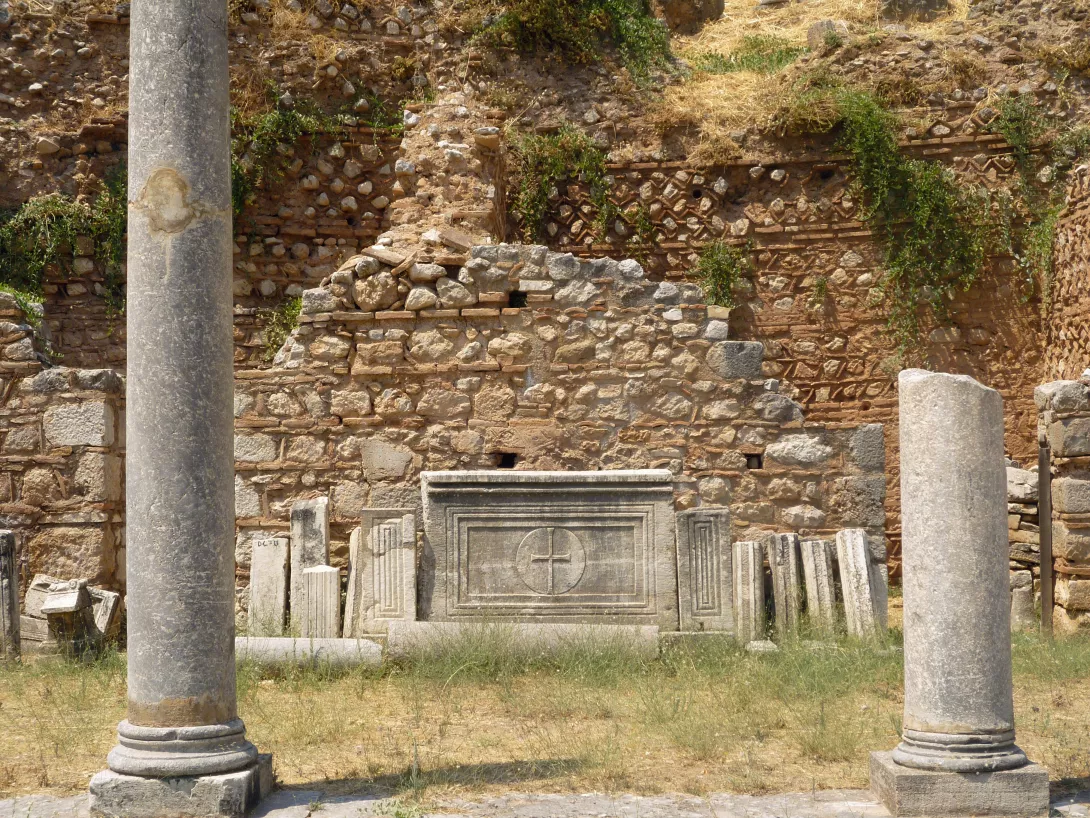
Following the Edict of Theodosius in 392, which banned pagan worship in the Roman Empire, a Christian town with its own churches developed within the sanctuary of Delphi and persisted until the 12th century. The remains of the Roman agora and the Christian basilica can be seen along the Sacred Way.
Delphi: ruins of the Christian city | 1
 Delphi, the Christian city | 2
Detail of the Christian city at Delphi.
Delphi, the Christian city | 2
 Delphi, the Christian city | 3
Fountain in the Christian city of Delphi.
Delphi, the Christian city | 3
 Delphi, stele.
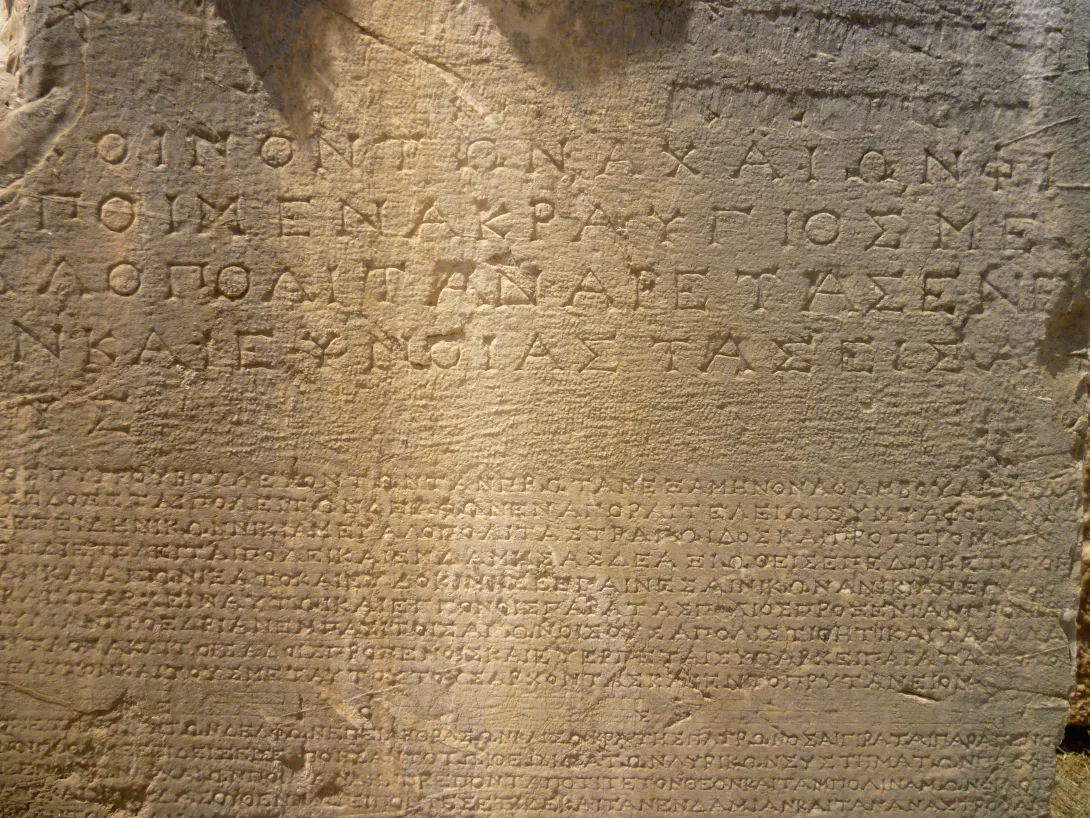
Stele with inscriptions at the site of Delphi.
Delphi, stele.
 Delphi, the Athenian Treasury
The treasuries were "chapels" built by various Greek cities to house the offerings of their citizens. They were built to mark an important event. The one in Athens, erected around 490–480 B.C., was among the most significant and commemorates the victory in the Battle of Marathon against the Persians. It adjoins the Council Chamber (Vouleutirion), where the Amphictyony—that is, the assembly of representatives from the Greek tribes responsible for managing the site of Delphi— used to meet.
Delphi, the Athenian Treasury
 Le portique des Athéniens à Delphes
Portique (stoa) des Athéniens devant le temple d'Apollon : sur la Voie sacrée, le chemin conduisant au temple d'Apollon, plusieurs bâtiments s'étaient construits, des édifices, des portiques, des trésors et des statues, offrandes ou commémorations d'un évènement.
Le portique des Athéniens à Delphes
 Delphes, colonne ionique
Delphes, colonne ionique
 Delphes, le temple d'Apollon | 1
Le temple d'Apollon, ce qu'il en reste aujourd'hui, date du 4e siècle av. J.-C., mais il aurait été construit par dessus un autre temple datant du 6e siècle av. J.-C., lui-même construit sur un temple datant du 7e siècle av. J.-C.
Delphes, le temple d'Apollon | 1
 Delphes, colonnes du temple d'Apollon | 2
Colonnes doriques du temple d'Apollon.
Delphes, colonnes du temple d'Apollon | 2
 Delphes, temple d'Apollon | 3
Delphes, vue des colonnes du temple d'Apollon.
Delphes, temple d'Apollon | 3
 Delphes, le temple d'Apollon | 4
Au cœur du sanctuaire de Delphes, le temple d'Apollon, lequel, selon une des légendes, aurait construit lui-même le temple. Il s'appelle alors Apollon Pythien pour avoir tué le serpent "Python" qui gardait l'oracle de Thémis.
Delphes, le temple d'Apollon | 4
 Delphes, le théâtre
Le théâtre de Delphes où avaient lieu les concours de musique, de poésie et de théâtre, surplombant le temple d'Apollon. Construit au 4e siècle av. J.-C., il a subi plusieurs réaménagements notamment à l'occasion de la visite de l'empereur Néron en 67 av. J.-C.
Delphes, le théâtre
 Delphes, le stade | 1
Le sanctuaire de Delphes avait aussi son stade où se déroulaient des jeux similaires à ceux d'Olympie : gymnastique, courses, lutte, chant, etc.
Delphes, le stade | 1
 Delphes, le stade | 2
Delphes, le stade | 2